


A framework for young people’s religious involvement
Three factors consistently emerge as anchors for why some young people remain connected to religious communities.
In 2025, Springtide Research Institute interviewed and surveyed young people, ages 13 to 25, from across the US to learn why some young people remain involved in religious or spiritual organizations. Across our study, three factors consistently emerge as anchors: parents, peers, and personal belief. Taken together, these three dimensions offer a framework for understanding why some young people remain connected to religious communities and what sustains their involvement over time.
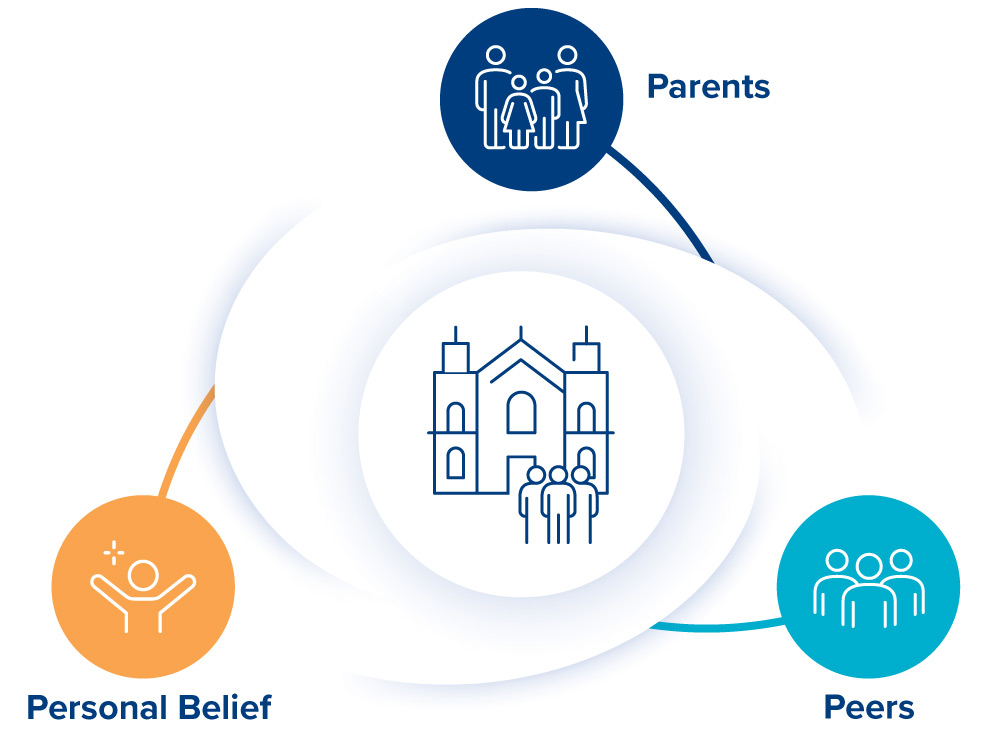
Parents
Family members, particularly parents and grandparents, play an essential role in the development of religious identity and involvement for young people. Almost two-thirds (60%) of the young people in our study continue to identify with the religious tradition in which their caregivers raised them.
“If my parents weren’t Catholic, I probably wouldn’t be going to church. And if my mom hadn’t signed me up for [soccer club] when I was five, I probably wouldn’t be playing soccer. And so, I feel like if you don’t have a strong family, then it’s easy to look other places that aren’t communities for filling up your time.”
–Isaac, age 15, Catholic
Peers
While family often introduces young people to religious and spiritual communities, peers play a central role in helping young people feel belonging in these spaces. Having friends in religious groups can turn participation into something joyful and meaningful, creating opportunities for belonging and shared experiences.
“My favorite group wasn’t [run by] an adult, technically it was [run by] teenagers. Some were over 18, but none were past 20. So, I think it felt a lot easier to connect with them because it felt like they were kind of at our stages in life as well. And we were in the same age group, which I think is really important, especially for a youth group to feel like you’re not judged by an adult or that you just have other peers that are similar to you that you can connect with. So, I definitely preferred the one where we had younger leaders.”
–Ronnie, age 16, spiritual but not religious
Personal Belief
When asked about how important religion is in their lives, almost half (47%) of respondents say it is among the most important things or the most important thing in their life. For many, this commitment is rooted in personal belief. Young people describe going to religious services or praying as ways to feel fulfilled, stay “on the right track,” or build their relationship with a higher power.
“There’s the social aspect for sure, but for me it’s just the personal side. Like, you’re gonna go and just get right with the Lord, go feel the spirit, go more [for] Jesus Christ and stuff. And that, for me, is important in my life that I wanna keep doing, that I wanna keep up with. And soo, I do make an effort to go. . . . I just feel good afterwards. I don’t know how to explain it. But I just feel fulfilled, like I’m on the right track for my life. I’m following through with what I want my life to look like.”
–Conrad, age 22, LDS
Download a PDF of this framework, Parents, Peers, & Personal Belief: A Framework for Young People’s Religious Involvement, by filling out the form at the top of this page.
Want to see the quantitative data behind this framework? You can check out, The Four Dimensions of Young People’s Spiritual and Religious Lives, here.