

Research on Catholic Teens and Young Adults Today
Explore data on Catholic identity, participation in the Church, disaffiliation, and young Catholic's thoughts on gender roles
Catholic young people in the US often appear in competing narratives. Some observers point to declining affiliation and disengagement, while others describe signs of resurgent interest and vitality. Underlying many of these stories are shared questions about retention: Who continues to identify as Catholic over time and why? What are the conditions under which Catholic affiliation is more or less likely to persist? In 2025, Springtide Research Institute surveyed over 1,000 young people and interviewed 20 more to document patterns in Catholic (dis)affiliation, relationships, and practice among young people in the United States.
Key Findings
Family tradition, personal belief, identity, and emotional support among top reasons why young Catholics remain affiliated
We asked Catholic teens and young adults why they continue to identify or practice as Catholic. The word cloud below visualizes the most frequently used terms in respondents’ open-ended responses to this question.
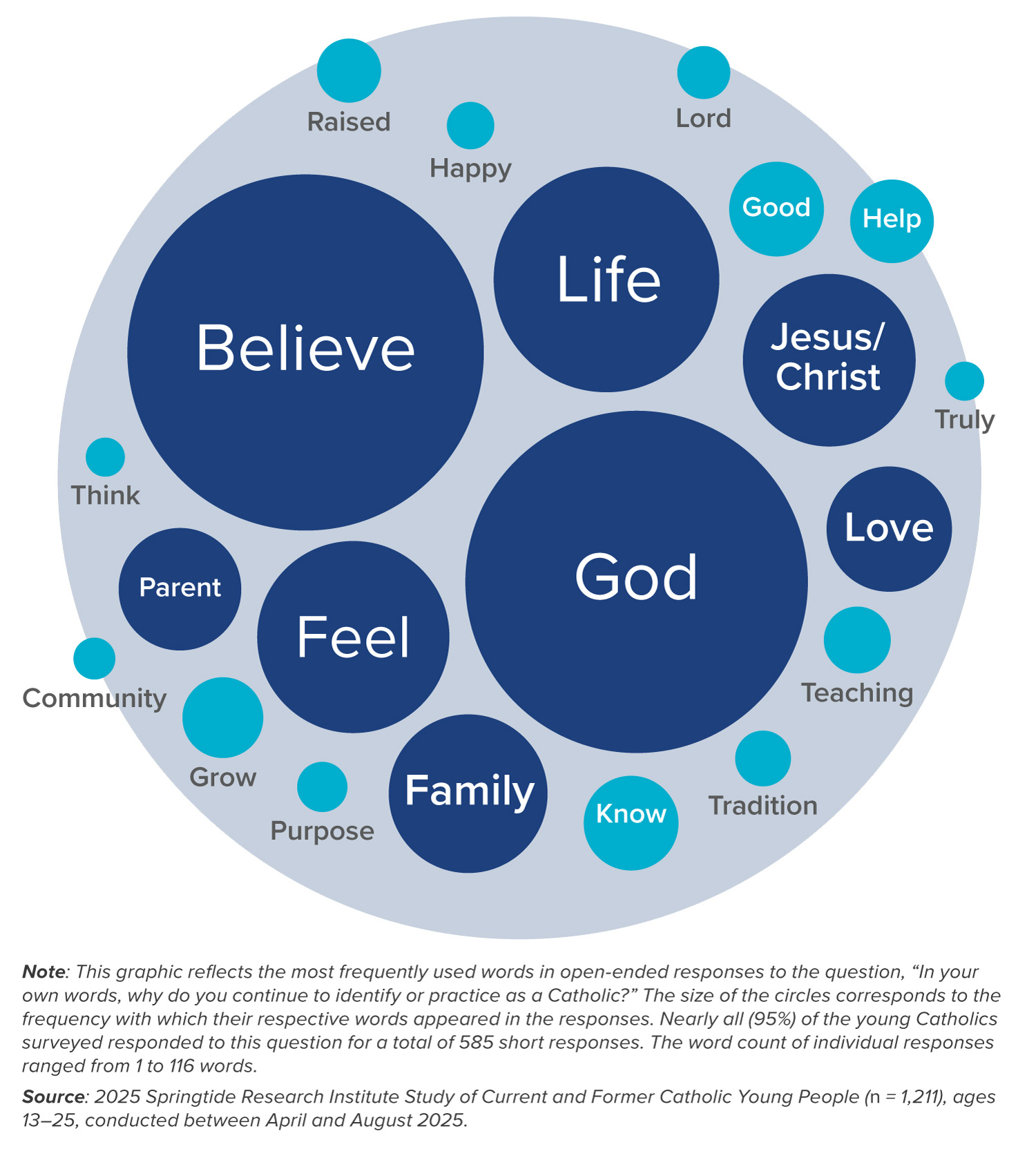
These terms—words like believe, family, feel, love, know, help, and happy, among thers—suggest young Catholics’ commitment to their faith is lived, felt, and relational.
Race/ethnicity emerges as the strongest predictor of Catholic disaffiliation
Patterns of disaffiliation surface across social characteristics like race and ethnicity, political ideology, LGBTQ+ identity, and gender, though the strength of these associations varies.
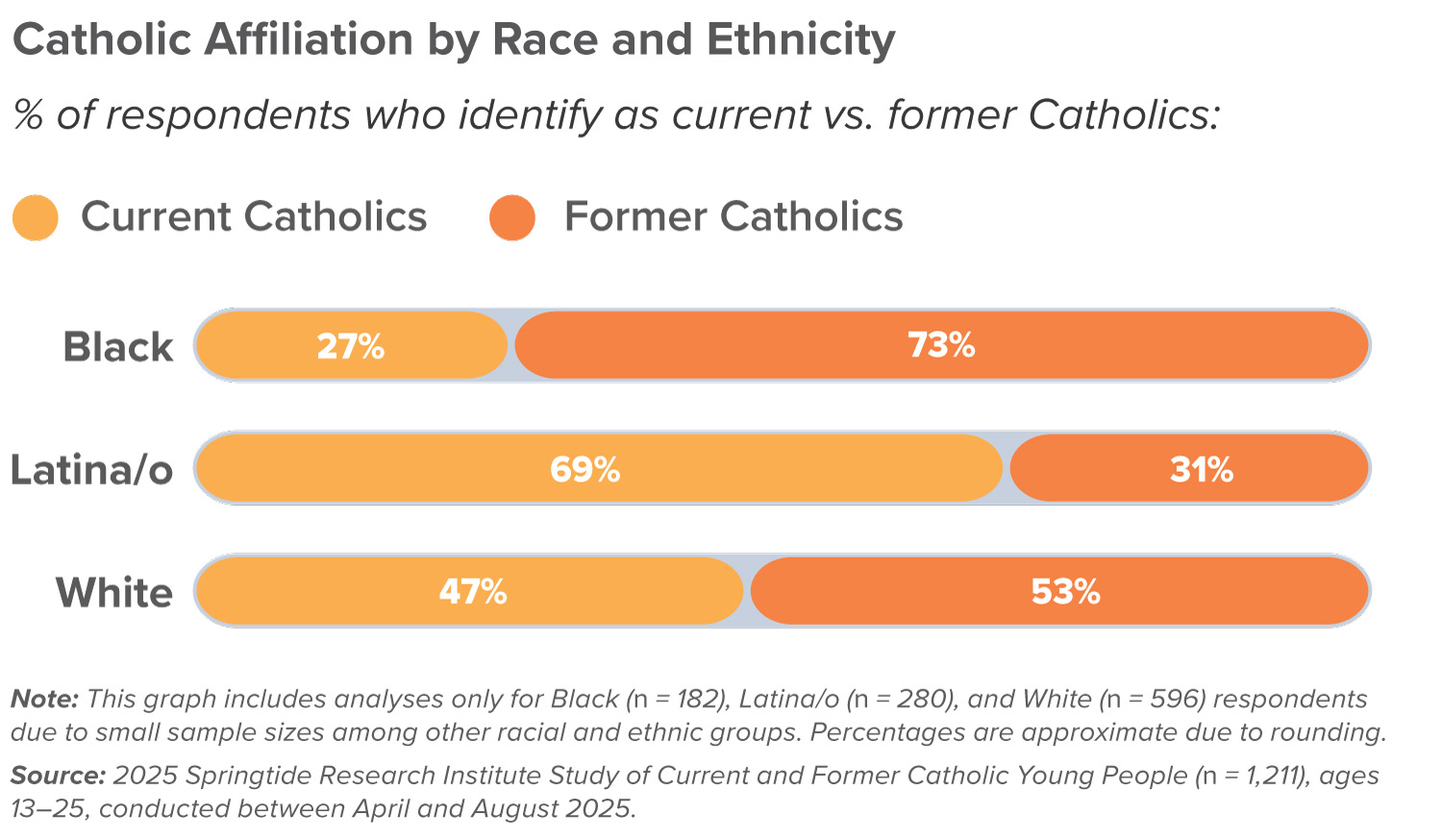
Disaffiliation is most common among Black respondents, nearly three-quarters (73%) of whom report no longer identifying as Catholic. White respondents are roughly evenly split between current (47%) and former (53%) Catholic affiliation. Hispanic and Latina/o young people show higher levels of retention, with fewer than one-third (31%) identifying as former Catholics.
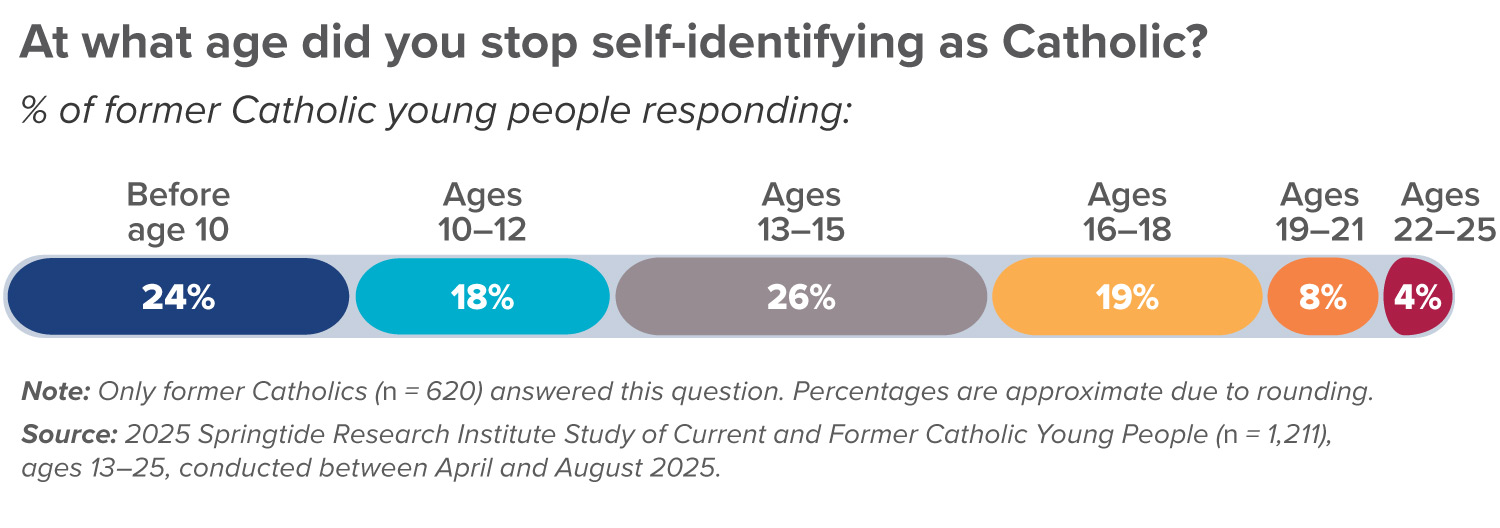
Most former Catholics report leaving the Church during adolescence
Half of former Catholics report disaffiliating during adolescence: 42% of former Catholics stopped identifying as such before turning 13, and 87% disaffiliated by age 18. Most say it is unlikely they will ever identify as Catholic again.
For teens and young adults, Mass attendance varies by affiliation
Across the full sample, Mass attendance is infrequent. Nearly half (48%) of respondents report never or rarely attending Mass aside from weddings and funerals, while 17% attend a few times a year, and 14% attend once or twice a month. By contrast, 22% of current and former Catholic young people attend once a week or more.
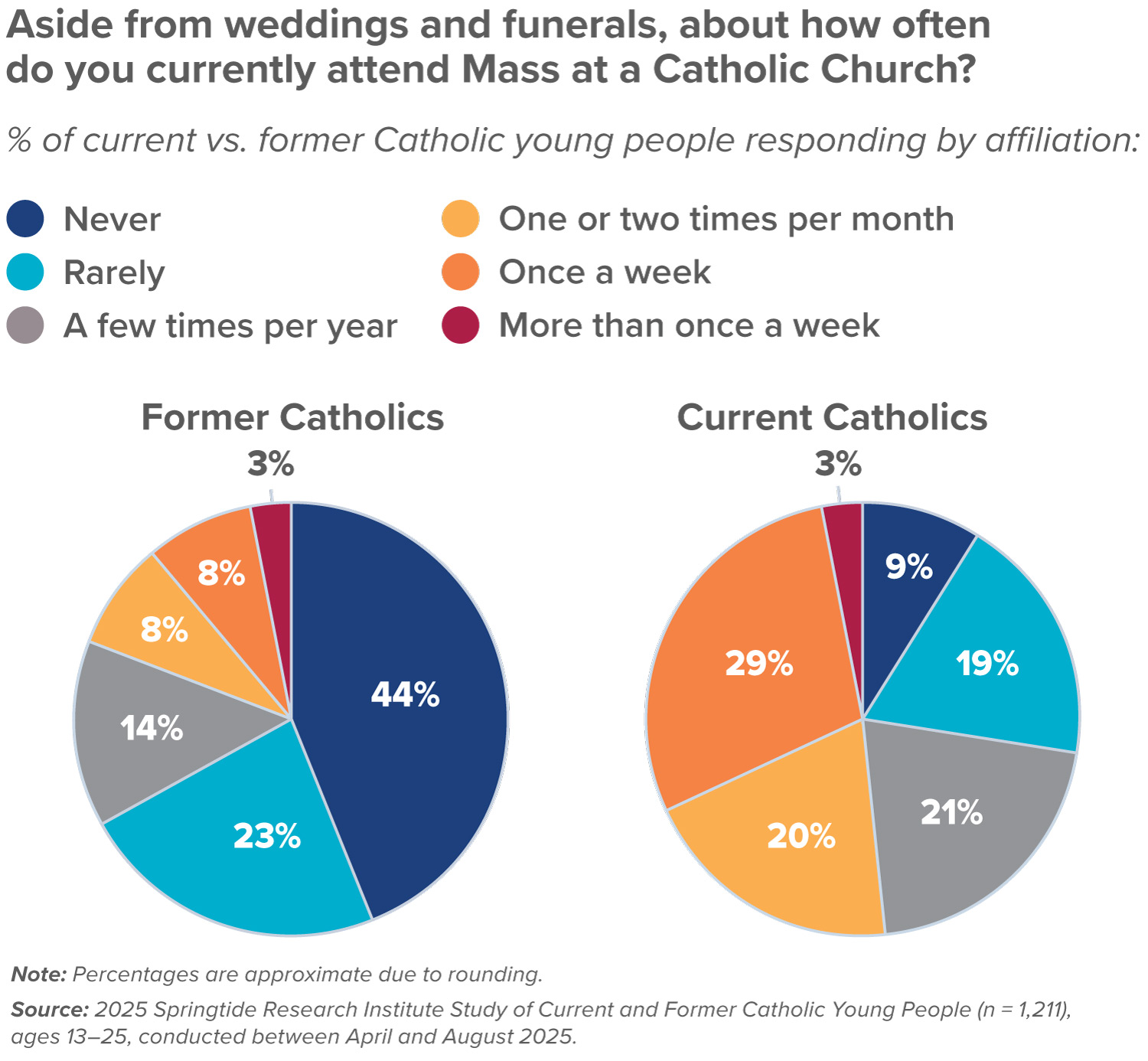
Perhaps unsurprisingly, Mass attendance varies sharply by Catholic affiliation. Under half (44%) of former Catholic respondents report never attending Mass, compared to 9% of Catholic respondents. Catholics are more concentrated at the high end of the attendance spectrum: 32% attend Mass weekly or more, compared to 8% of former Catholics.
Parents surface as strong sustainers of Catholicism
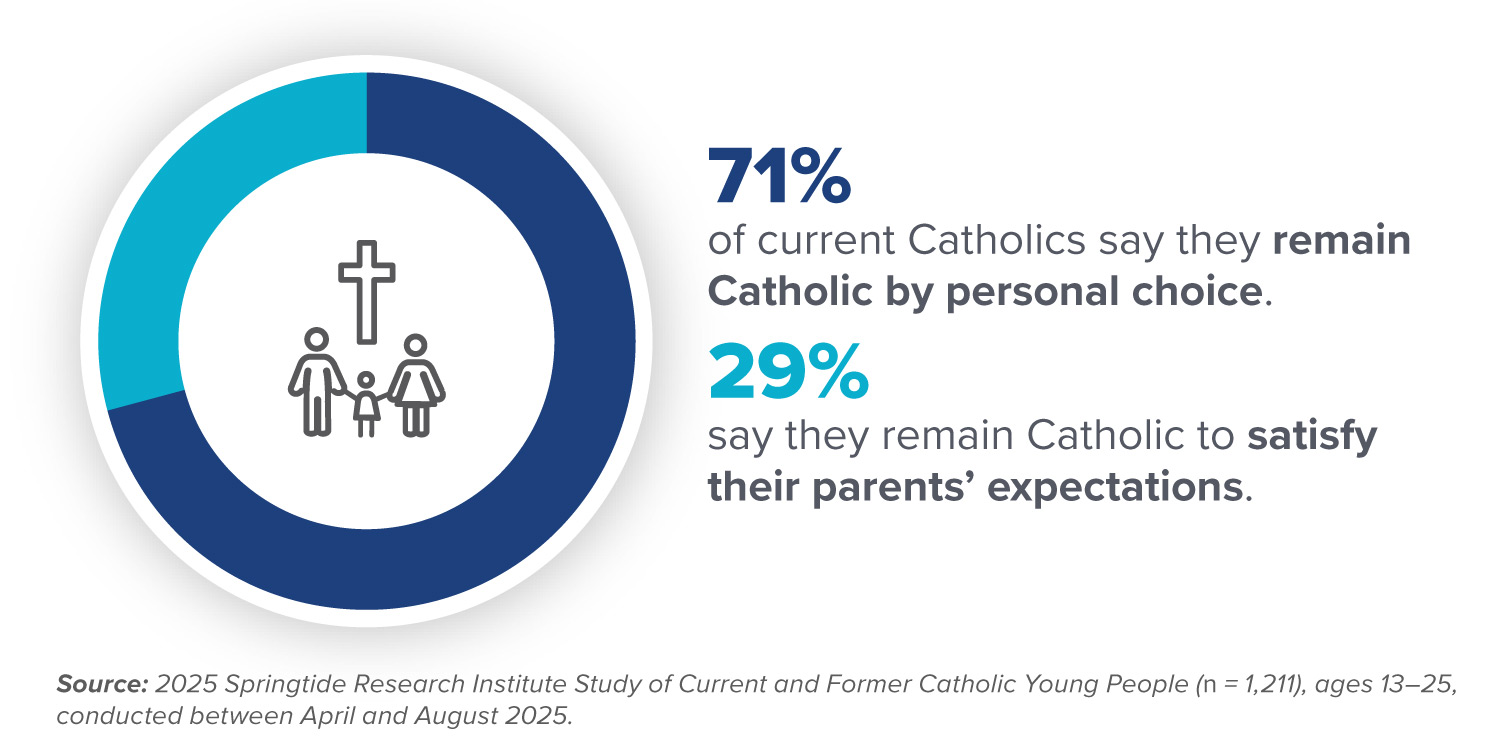
Catholic young people most commonly cite family tradition as the reason why they continue to identify or practice as Catholic. Parents in particular surface as strong sustainers of the faith. Respondents whose mothers currently identify as Catholic are more likely to identify as Catholic and say they expect to remain Catholic in the future. Fathers’ Catholic affiliation is also associated with retention, though the differences between those with and without Catholic fathers are smaller than those observed for mothers.
Many young Catholics support expanded leadership roles for women in the Church
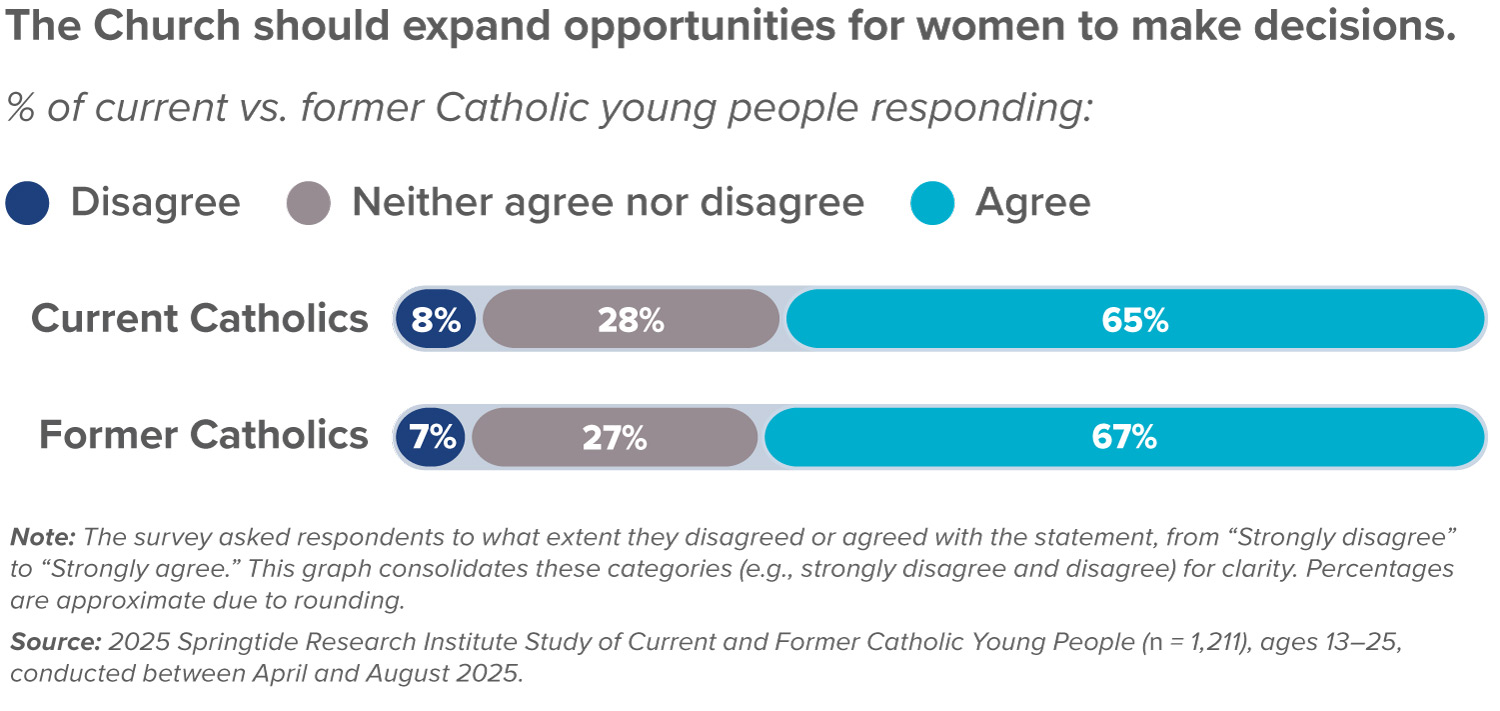
Current and former Catholics in this study reveal nuanced and sometimes unresolved views about gender roles in the Church and in society. Many support expanded leadership roles for women in the Church but are divided on questions about sacramental authority. There are respondents who affirm some traditional role expectations—especially for men—while others express disagreement or uncertainty.
Download the full report by filling out the form at the top of this page.
Want to see the quantitative data from young people across religious and spiritual identities? You can check out, The Four Dimensions of Young People’s Spiritual and Religious Lives, here.